Diagnosis of leptospirosis in various animal species via detection of DNA and host immune response.
Available Clinical Testing
| Test | Sample Requirement | Comments |
|---|---|---|
| Leptospira Panel (Serology & PCR) | Urine (3-5ml) AND Whole Blood (lavender top 3-5ml) AND Serum or Plasma (1-2ml) | Best choice for diagnosis of clinical leptospirosis. |
| Leptospira Panel (PCR only) | Urine (3-5ml) AND Whole Blood (lavender top 3-5ml) | Detects Leptospira DNA using LipL32 gene based Real Time PCR to detect pathogenic Leptospira in clinical samples with high sensitivity and specificity |
| Leptospira PCR | Urine (3-5ml) OR Whole Blood (lavender top 3-5ml) OR 0.5-2 inch piece of tissue | PCR is performed same day as submission if submitted before 10am on weekdays. |
| Leptospira Serology (Microscopic agglutination test) | Serum or Plasma (1-2ml) | Detects agglutinating antibodies to 12 Leptospira serovars. Performed once weekly Wednesday or Thursday. |
*Direct immunofluorescence, darkfield microscopy, and culture also performed in our research laboratory please call prior to collection if interested in these testing options.
For pricing refer to UTCVM Biomedical and Diagnostic Sciences Laboratory Resources
Frequently Asked Questions
Leptospirosis can manifest as a biphasic infection shifting between clinical disease and reservoir/shedding status. Proper sampling and testing selection based on stage of infection is key to clinical diagnosis.
Dynamics of infection in an untreated clinical leptospirosis case.
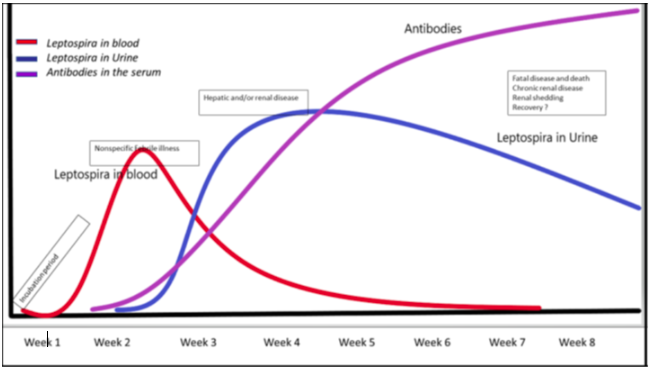
Positive Urine PCR – confirms renal colonization in animals with clinical disease and animals with asymptomatic renal colonization.
Positive Blood PCR – indicates leptospiremia which in a symptomatic patient is diagnostic of clinical leptospirosis.
Positive MAT – indicates the presence of agglutinating antibodies to Leptospira, which can be the result of vaccination or previous exposure. A serum titer of above 1:800 combined with clinical signs in an unvaccinated animal can be suggestive of active infection. This test is best combined with PCR or with serum samples paired 6 weeks apart.
In cases of abortion and reproductive failures in livestock herds, a herd level screening is available for 15 animals per herd. After administration of a diuretic 5-20ml of midstream catch urine can be submitted from each animal along with corresponding serum samples for PCR and immunofluorescence testing. Please call prior to collection if you are interested in this option.
Serum and aqueous humor are recommended samples for confirmation of Leptospira ERU. MAT testing will be performed on both samples as well as PCR on the aqueous humor, 250µl of aqueous humor is preferred for both tests. Vitreous humor can also be tested using MAT and PCR if available.
We offer an extended panel including 12 of the most common serovars.
Autumnalis
Ballum
Bataviae
Bratislava
Canicola
Copenhageni
Gryppotyphosa
Hardjo
Icterohemorrhagiae
Mankarso
Pomona
Tarrasovi
*Add which serovars are in the canine/cattle/porcine/equine vaccines.*
For any other questions please email Dr. Sree Rajeev at srajeev@utk.edu or the bacteriology laboratory at bacteriology@utk.edu or give us a call at 865-974-5639.