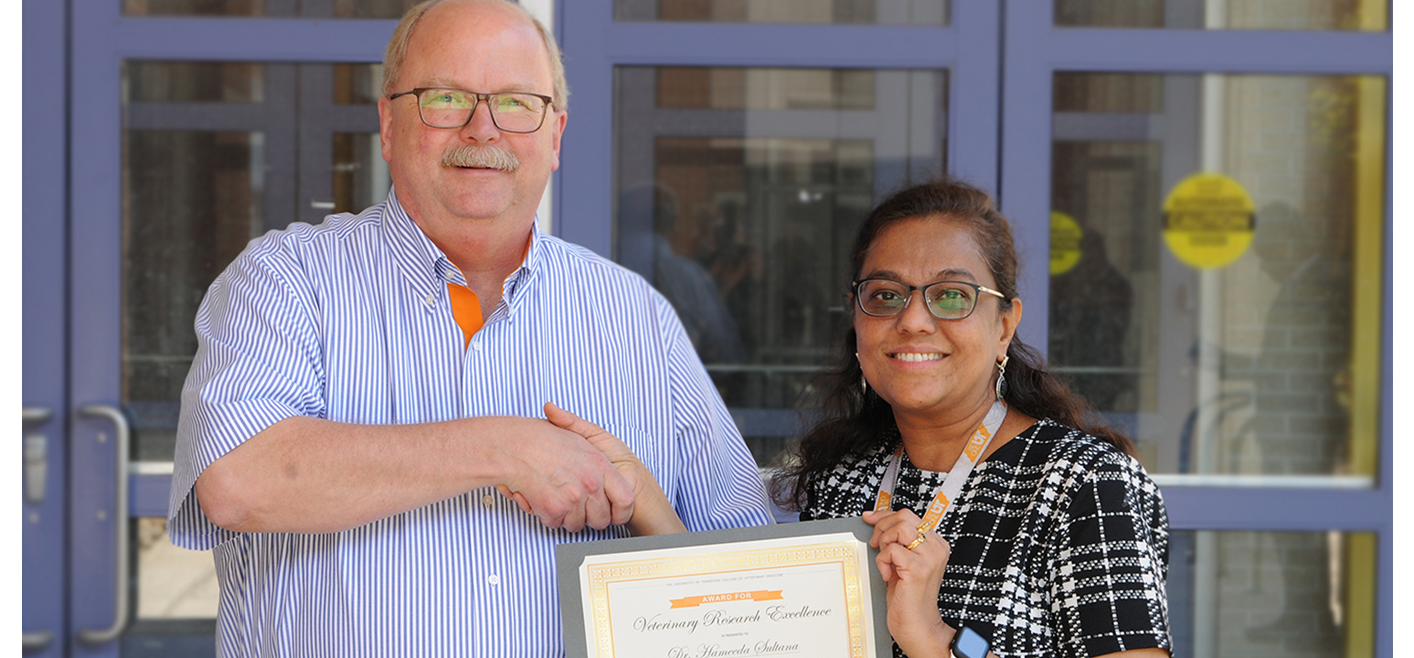
Hameeda Sultana, Professor at the University of Tennessee College of Veterinary Medicine Department of Biomedical and Diagnostic Sciences, has received the 2026 Zoetis Award for Veterinary Research Excellence.
The award recognizes a faculty member whose innovative studies have advanced the scientific standing of veterinary medicine at the college. Its purpose is to foster the innovative research on which scientific advancement in the veterinary profession depends by recognizing outstanding research efforts and productivity.
Dr. Sultana has built a distinguished research career focused on infectious disease, vector biology and molecular mechanisms of vector-borne diseases. Her research program examines how arthropod-borne pathogens are transmitted between vectors and their human and animal hosts, with a particular emphasis on exosomes and extracellular vesicles. Her work explores new approaches to disrupting transmission of tick- and mosquito-borne diseases, including West Nile, Zika, dengue and other flaviviruses.

“This recognition means a great deal to me and supports the continuity of my research. It acknowledges years of hard work advancing this novel line of investigation into arthropod exosomes and their interactions with humans and animals,” said Dr. Sultana. “This research is directly related to One Health, and the award motivates me to pursue additional research funding and publish our work in high-impact, highly regarded journals. I sincerely thank the nominators and everyone else who contributed to this award recognition.”
Sultana earned her PhD in medical biochemistry from the University of Cologne in Germany and completed her postdoctoral training at Yale University School of Medicine, including work supported by the Howard Hughes Medical Institute. Before joining UTCVM, her research examined West Nile virus, tick-borne pathogens, neurobiology and host-pathogen interactions.
Her innovative research at UTCVM has been supported by significant National Institutes of Health funding, including a National Institute of Allergy and Infectious Diseases R01 award of nearly $2 million and an additional supplemental award of $219,000 to examine the role of arthropod exosomes in vector-pathogen interactions. She has authored 65 peer-reviewed publications and delivered numerous invited presentations at national and international scientific meetings.
“This year’s recipient, Dr. Hameeda Sultana, has built a distinguished research career focused on infectious disease, vector biology and molecular mechanisms of vector-borne, diseases,” said David Anderson, associate dean for research and graduate studies at the veterinary college. “Her continued commitment to advancing our understanding of vector-borne disease and developing new strategies to combat pathogen transmission makes her highly deserving of this recognition.”
Dr. Sultana’s work reflects the One Health approach by addressing diseases that affect people, animals and the environments they share.