
UT Researchers Discover Protein That May Block Disease Transmission
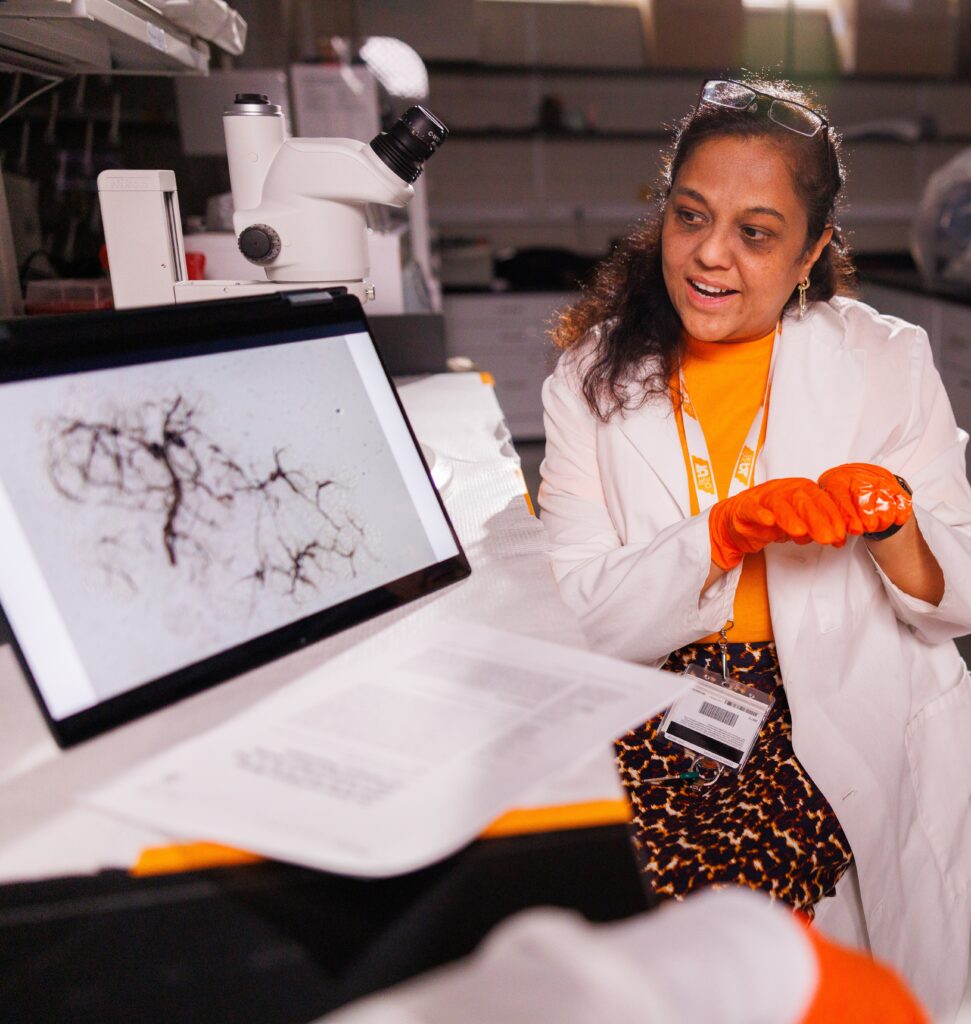
Few creatures inspire as much universal dislike as ticks. Though small, these parasites have an enormous impact on human and animal health. Each year, ticks spread viruses and bacteria that infect people, livestock, wildlife, and pets around the world. Scientists at the University of Tennessee College of Veterinary Medicine are working to better understand how ticks transmit these diseases—and how to stop them.
In a new study published in The EMBO Journal, researchers identified a tick protein that could help block disease transmission before it fully happens. The EMBO Journal, published by the European Molecular Biology Organization, is one of the world’s leading journals in molecular biology.
The research was led by professor Hameeda Sultana and alumni postdoctoral fellow Waqas Ahmed, and contributors included former graduate students Wenshuo Zhou and Kehinde Fasae, current graduate student Md Bayzid, and faculty collaborators professor Girish Neelakanta and former UT clinical assistant professor Denae LoBato. Supported by Sultana’s R01 funding from the National Institutes of Health (R01AI141790 and R01AI141790-05S1), the work highlights the UT Institute of Agriculture’s role in advancing research on vector-borne diseases.
Between 2018 and 2020, Sultana’s laboratory was the first to identify exosomes derived from tick saliva and salivary glands and from tick and mosquito cells. In this groundbreaking work, the UT research team discovered that ticks produce an exosomal glycine-rich protein that plays a vital role in helping ticks feed and transmit viruses. “Exosomes are tiny bubble-like vesicles with messages in them,” explains Hameeda Sultana. “They are tiny membrane-bound particles that transport proteins and other biological signals between cells and tissues.”
When a tick bites its host, the interaction is more complex than it may appear. Tick saliva contains exosomes filled with a sophisticated cocktail of molecules, allowing them to feed undetected while avoiding triggering the host’s immune defenses. These vesicles carry a variety of tick proteins that may help pathogens move between ticks and hosts. “They contain several arthropod proteins that could facilitate tick feeding, pathogen acquisition from infected hosts to naïve ticks, and transmission of pathogens from infected ticks to naïve hosts,” Sultana says.
When the researchers used genetic tools to silence the gene responsible for this protein, the effects were dramatic. Ticks lacking the protein struggled to feed effectively and showed reduced body weight after feeding. Even more importantly, virus levels were significantly lower. The findings build on years of work exploring how ticks use microscopic vesicles to interact with their hosts.
The researchers also investigated whether the protein could be used in a vaccine approach.

Faculty collaborator Girish Neelakanta says discoveries like this highlight how understanding tick biology can reveal new opportunities to prevent disease transmission. “Ticks transmit several pathogens,” Neelakanta explains. “Studies like this provide evidence about tick molecules that play an important role not only in tick biology but also in the interactions with pathogens.”
Researchers believe exosomes could become an important target for disease prevention strategies. “Since the identification of exosomes from ticks from my laboratory, several studies—including our own—have emphasized the importance of these vesicles in tick feeding and interactions with pathogens,” Dr. Sultana says. “This is an exciting area of research that could open several avenues for the development of arthropod exosome-based strategies to target vector-borne diseases.”
According to Neelakanta, targeting these molecules may offer a new way to interrupt the transmission cycle. “Targeting this type of protein might be an ideal approach to affect transmission of several pathogens from ticks.” This type of approach is known as a transmission-blocking vaccine. Rather than targeting the virus itself, the vaccine targets a molecule in the tick, preventing the tick from successfully feeding or transmitting pathogens. By interrupting this process early, scientists hope to stop infections before they ever reach the host.
As tick-borne diseases continue to increase worldwide, the need for new prevention strategies is becoming more urgent. Current control methods rely on avoiding tick bites or reducing tick populations. However, researchers are increasingly investigating ways to interfere with the biological mechanisms ticks rely on to feed and transmit disease.
The discovery of this exosomal protein adds to a growing body of research exploring how parasites communicate with their hosts at the microscopic level. Scientists are still in the early stages of understanding the role exosomes and other extracellular vesicles play in these complex interactions.
Findings like these demonstrate how fundamental molecular biology research can lead to practical advances in both animal and human health. By uncovering the hidden mechanisms ticks use to spread disease, scientists are opening the door to innovative new strategies for prevention.
Sometimes the best way to stop a parasite is to understand it at its smallest scale. In this case, the key to combatting ticks may lie within microscopic packages only billionths of a meter wide. One day, these tiny messengers could help prevent the spread of vector-borne diseases.
Citation:
Ahmed W, Zhou W, Bayzid M, LoBato DN, Fasae KD, Neelakanta G, Sultana H (2026) Arthropod exosomal glycine-rich protein as a potential vaccine candidate effectively reduces tick blood-feeding and pathogen transmission. EMBO J 45: 2051-2073. DOI: 10.1038/s44318-026-00709-z